
NBA Draft Combine: Are you jumping to conclusions?
A look at biases, research data, horse racing and dancing.

When I try to explain the concept of pre-draft evaluation to people who don’t follow sports, I usually tell them to picture the moments right before a high-stakes horse race. Picture that brief window where the thoroughbreds and their jockeys walk in a slow circle in front of the grandstand, giving the spectators one last chance to look them over.
For the bettors in the crowd, it’s a fascinating additional data point before placing their chips. Some people will look at that parade and completely convince themselves that they can spot true fluidity, stride length, and a “will to win” burning in the eyes of the horse. Others will dismiss the entire spectacle out of hand as pure theater. The right approach, as is usually the case, lies somewhere in the pragmatic middle: you check the animal for obvious short-comings—like an underlying sign of injury—and you lock into the hard, undeniable measurements, namely the weight of the horse and the jockey.
Cut to the basketball world, where we have our very own version of this parade. With the 2026 NBA Draft Combine taking place this week, the annual cycle of hype and overreaction has officially reached its peak.
But when the modern Combine rolls around, we aren’t watching a quiet, clinical circle; we are watching a hyper-commercialized “higher, faster, stronger” media event. For front offices and draft analysts, a fresh batch of measurement data from Chicago is always a seductive invitation to place new bets. Some will look at a player during an empty-gym shooting drill and convince themselves they see star potential; others will write off the whole week as noise.
In the middle of all the flashing neon and viral tweets from this week’s testing, what should we actually be paying attention to, and what is pure deception? What raw material from Chicago deserves to be ingested into the models at ProspectTheory.io, and what is simply noise?
Luckily, you don’t have to guess. I spent years digging into draft-realted dilemmas for my doctoral dissertation. For one paper I analyzed all available historical combine data and published my peer-reviewed findings so you don’t have to do the heavy lifting. As it turns out, the draft market isn’t just looking at the wrong things—it is actively jumping to conclusions.
Navigating a Psychological Minefield
The NBA Combine is dangerous terrain, primarily because it is paved with cognitive biases. It is a breeding ground for analytical traps where front offices and fans alike frequently mistake physical capacity for basketball abilities. If you don’t anchor yourself in data, your brain will lie to you.
Here are the primary biases at play in Chicago this week:
Confirmation Bias: Hunting for Proof
The truth is, almost nobody walks into the Combine with a genuinely open mind. We all enter the week with pre-existing narratives about these players, and we unconsciously use the testing drills to hunt for confirmation of our own beliefs.
Did you really look at the athletic leaderboards this week with total objectivity? Or were you just looking for a low vertical leap to finally justify sliding down that less athletic player you never liked anyway? On the flip side, we routinely use decent testing scores to praise the walking highlight reels we already enjoy watching so much. We don’t look for truth at the Combine; we look for evidence to support our own already formed opinions.
Availability & Aesthetic Bias: The Boozer vs. Wilson Illusion
A perfect example of this played out on Twitter just a few days ago. A viral tweet compared the agility times of two of the top prospects in the class:
BullsKickAss @Bullskickass Cam Boozer vs Caleb Wilson Agility Time! 12:28 AM · May 13, 2026 · 1.36M Views
Looking at the film and the discourse around it, people immediately deemed Cameron Boozer to be “slow.” There is an aesthetic bias at play here: Wilson looks like he hustles more, his movements are flashier, and our brains are flooded with the memory of his spectacular highlight plays.
This is the Availability Bias in its purest form. We remember eventful stuff. Spectacular blocks and thunderous dunks stick in our minds, and those events get replayed on a loop by media outlets or on social media. But basketball is inherently also a game of non-events. It’s about the pristine positioning that prevents the need to block a ball in the first place, or simply not turning the ball over.
Because our brains over-index on the flashy plays we can easily recall, we assumed Wilson would blow the doors off the agility test. The reality check? Boozer actually clocked in with the faster time.
Overconfidence Bias: The “Lump of Clay” Delusion
The Combine regularly triggers an immense overconfidence bias among general managers. The prevailing mindset in front offices is often: “Give me the elite athlete, and my coaching staff will teach them how to play basketball.”
Explosive, physically gifted players consistently get overdrafted because of the age-old draft maxim: you can’t teach height—or wingspan, or quick-twitch muscle fibers, or raw speed. And while that is true to a degree, practice can only get you so far.
What GMs forget is that the exact same rule applies to high-end NBA skill. Sure, you can teach a player to become a competent league-average shooter or a functional dribbler. But elite, high-end skill requires an innate talent of its own.
Yet, GMs continually approach player development from a position of ego. They want the athletic lump of clay because they are overconfident in their own ability to mold it. They want an active, controlling part in the development. But sometimes, the better bet is simply to trust the prospect, provide a functional environment, and let them cook. Highly skilled players have spent their entire lives figuring out the physical limitations of the game on their own; they are used to solving that problem. If you guide them well, give them opportunities, and let them do their thing, they find a way.
Both roads can work. The Kawhi Leonards of the world can learn to shoot, and the Paul Georges can tighten their handles. But the market heavily underutilizes the alternative: getting the Steph Currys, Jalen Brunsons, and Nikola Jokics into the building—players whose true genius will never, ever fully show up in an empty-gym combine environment that tests for run and jump athleticism.
Institutional Risk Aversion Bias: The Loss Aversion Trap
This brings us to the very namesake of our project. In behavioral economics, Kahneman and Tversky’s Prospect Theory demonstrates that humans are inherently loss-averse—the pain of losing is psychologically twice as powerful as the pleasure of gaining. In NBA front offices, where job security is razor-thin, this manifests as a profound institutional risk aversion.
When a general manager is more worried about losing their job than maximizing absolute upside, their draft strategy shifts from value maximization to blame minimization.
It is incredibly easy for a GM to walk into an owner’s office and justify picking a chiseled Adonis who just recorded a historic vertical leap. If the player busts, the GM can point to the testing sheets and say, “Look at the tools. Everyone thought he had star potential.” The consensus protects him.
It is a much harder, higher-risk conversation to draft a player who looks like an Average Joe. To pick the unathletic-looking genius, you have to provide mountain-loads of context and complex spatial tracking data just to prove their massive positive impact they deliver through off-ball gravity, team friendly scalability and team defense. If that player busts, the GM looks foolish and gets fired. The Combine, therefore, provides a psychological escape hatch—an easy way out for risk-averse decision-makers who would rather fail conventionally than succeed unconventionally
The Great Combine Disconnect: Draft Behavior vs. Future Performace
My research uncovered a massive market inefficiency: while raw athletic testing has virtually zero correlation with long-term NBA success, it has a statistically significant impact on where a player gets drafted. GMs consistently use high-visibility Combine performances to justify moving a player up their board, letting a flashy 30-minute workout in Chicago override years of structured game tape. Front offices are paying premium draft capital for traits that don’t translate to wins, effectively paying for the packaging rather than the product. To fix this, we have to aggressively separate the illusion from reality.
Anthropometrics are genuinely important, especially wingspan and standing reach, which consistently show robust statistical significance in predicting defensive impact. However, the traditional “run and jump” athleticism is completely overrated. Functionality is key.
Smoke and Mirrors: The “Run and Jump” Mirage
The drills that generate the most viral tweets and empty-gym hype are almost entirely smoke and mirrors—and my research proved this mathematically. Max Vertical Jump, the Standing Vertical, and the Three-Quarter Sprint emerged as the ultimate illusions. They have a statistically significant, positive correlation with a player’s draft position—meaning they actively push prospects up the draft board—yet they show near-zero, non-significant correlations with actual NBA performance metrics like career Box Plus-Minus. Therefore this “raw athleticism” should be considered a latent variable. These traits show what a body can do in a sterile environment, rather than what a player will do when other people are on the floor in an in-game scenario.
Function over Form: The Shift to Functional Athleticism
True basketball athleticism is not measured by a tape measure against a wall; it is measured by how your physical gifts manifest within the flow of a game. A massive vertical is functionally useless if you lack the processing speed to time a rotation, and elite straight-line speed means nothing if you don’t possess the handle to utilize it under pressure.
We have to give immense credit to the pioneers like The Stepien for popularizing the concept of Functional Athleticism, even as the basketball world is still collectively figuring out how to precisely measure it. While a perfect, unified metric for functional athleticism doesn’t exist yet, we certainly know what it is not when we look at the historical extremes.
Think back to Kevin Durant, who famously couldn’t bench press 185 pounds a single time at his Combine, yet his functional fluidity and length allowed him to become an unstoppable basketball legend. On the flip side, look at Keon Johnson, the historic record-holder for the highest max vertical in Combine history at 48 inches, who is still fighting to establish himself as a consistent NBA player.
A Fun New Heuristic: Slow is Smooth, and Smooth is Fast
If you’re a fan of Modern Family, you might remember Phil obsessively reciting the old military mantra while trying to master a task: “Slow is smooth, and smooth is fast.” It’s a beautifully counterintuitive philosophy that perfectly explains why unathletic-looking dudes always seem to have something devastating in their bag.
But the truth is, the basketball world is actually quite new to this realization. For decades, a powerful Status Quo Bias has locked front offices and fans into a rigid definition of athleticism: if it doesn't look like track-and-field—if a player isn't flying down a straight line or exploding skyward—our brains struggle to categorize it as "athletic."
We are only just beginning to break out of that mental trap, understanding other concepts. We started talking about "hand-eye coordination" to explain the wizardry of Steve Nash and Stephen Curry. Then, we evolved to talk about "stopping ability" or deceleration to break down how Luka Doncic and James Harden create space without elite burst.
We are slowly getting better at looking at the bigger picture. And that cute little heuristic—slow is smooth, and smooth is fast—serves as the perfect mental bridge. It allows us to bundle all these seemingly disparate traits into a single, intuitive framework of speed changes, shifting rhythms, and absolute smoothness.
Michael MacKelvie explains the idea I am borrowing from here in this awesome video:
If you squint hard enough, you realize that basketball isn’t a track meet; it is ultimately a dance. I mean, the great Jordan documentary got its name for a reason, right?
The crew in the video captured this beautifully when analyzing Kyrie Irving's masterclass in aesthetic control, noting that basketball is fundamentally more connected with Patrick Swayze and Jennifer Grey than you thought. It is a high-stakes remix of that iconic line from Dirty Dancing: "This is my dance space. This is your dance space." The offensive player is trying to manipulate rhythm and tempo to carve out their own dance space, while the defender is doing everything in their power to crash the party and disrupt the beat.
To survive in that environment, raw, unchanging speed is actually a liability. If you move at only one tempo, you are completely predictable. True functional athleticism requires the ability to be free-flowing, improvisational, and capable of navigating any spot on the floor at a moment's notice. It is about weaponizing your cadence—having absolutely zero extra wasted movement.
This brings us right back to the loop we started with in Chicago this week: the viral agility drill between Cameron Boozer and Caleb Wilson. When people watched the tape, their eyes lied to them because of the status quo bias. Wilson looked faster because his rhythm was frantic, but Boozer clocked the better time. Boozer carries significantly more weight than Wilson, which makes his faster time even more impressive. How did he do it? Efficiency of movement. No wasted steps. No erratic, jagged cuts. Just pure, smooth deceleration and acceleration. Boozer applied the heuristic: he was smooth, and because he was smooth, he was fast.
How is this knowledge incorporated in ProspectTheory.io?
1. The Primacy of Anthros
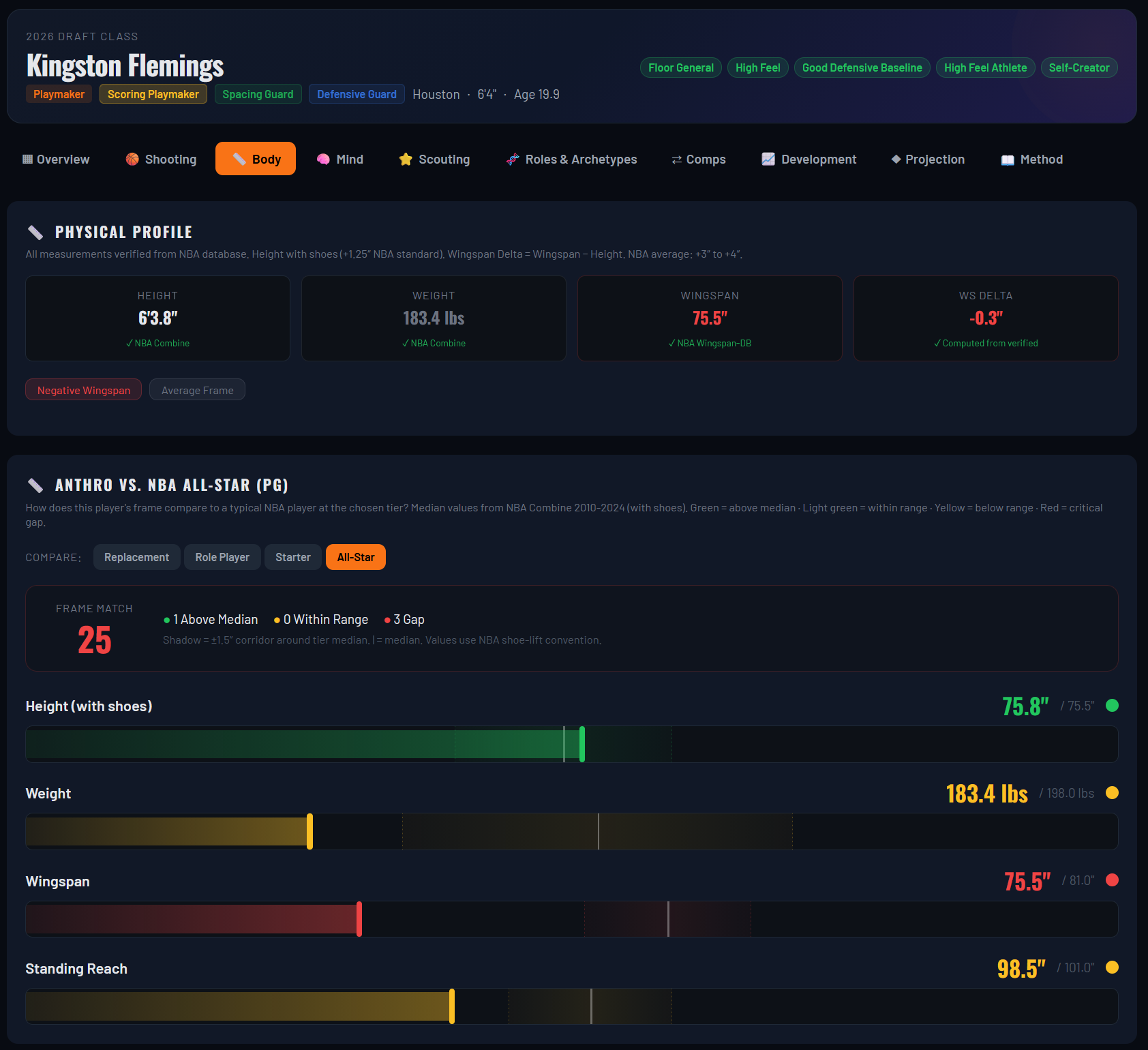
Because the underlying model heavily cares about anthropometric leverage—especially wingspan—I have freshly updated the former imputed anthro values for this week’s prospects based on the official measurements out of Chicago. Naturally, this caused some immediate risers and fallers across my Big Board.
Under the Body tab, I showcase these anthropometrics compared directly to other players from different historical performance tiers. You won’t find the traditional agility or sprint drills here; quite frankly, I don’t see enough predictive value in them to grant them real estate.
2. The Full Landscape
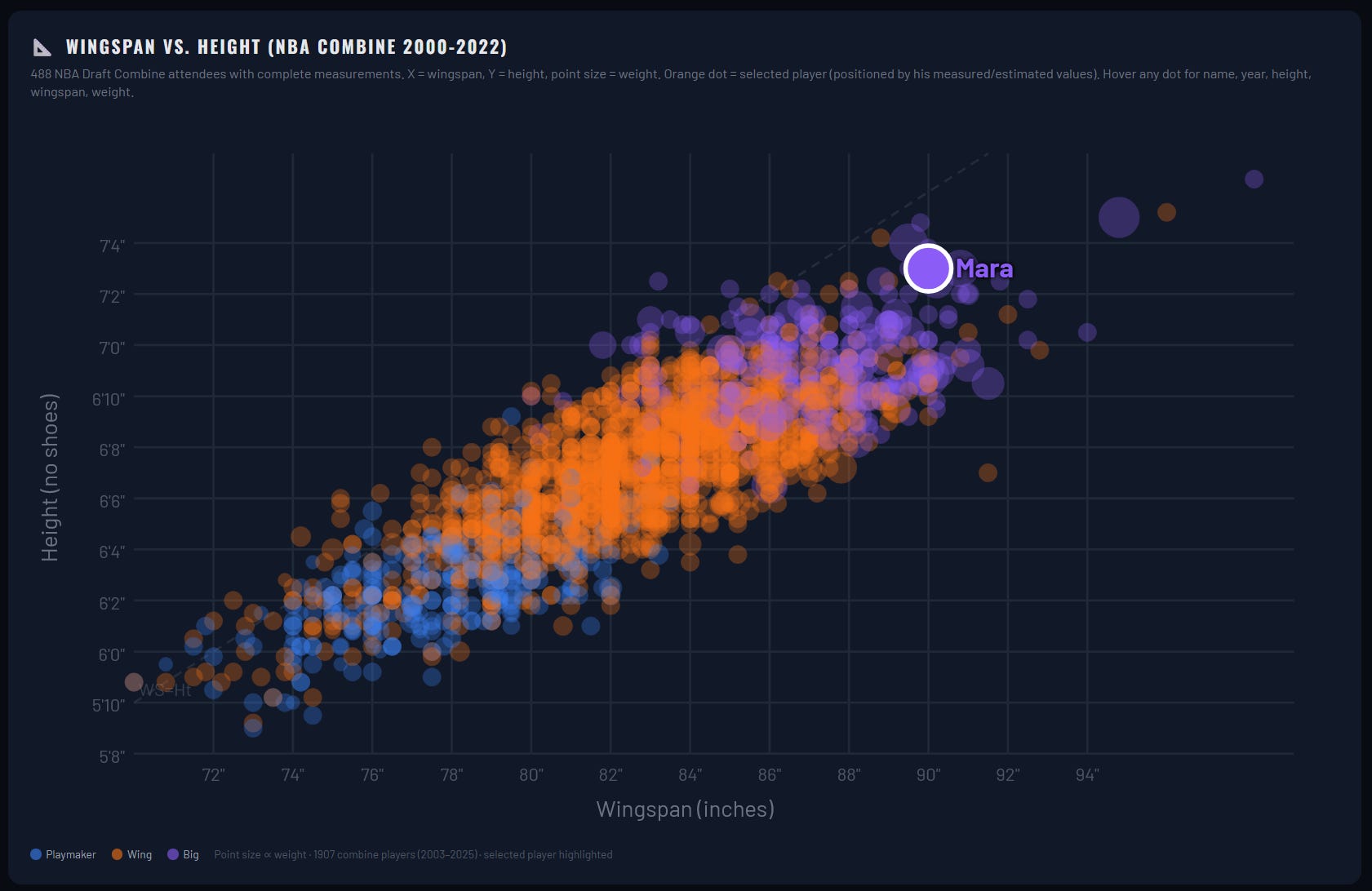
To give you a bird’s-eye view of how this class stacks up physically and functionally after the Chicago data drop, I feature a comprehensive overview plot for all 2026 draft prospects.
3. Quantifying the Dance: Functional Athleticism
Since you can’t measure true basketball movement with a stop-watch, I calculate Functional Athleticism directly from in-game events. This has become one of my core prospect scouting pillar numbers, mathematically incorporating a player’s dunks, stocks , rebounding and rim frequency.

The End: A Word of Caution
As powerful as these impressions from the NBA Combine are, a word of advice as you dig into the post-event data: use everything with caution. Treat these numbers as one data point in a picture of many. And beware of you biases.
Think back to where we started. You don’t want to base your entire bet on just one parade. Smart bettors don’t do this in horse racing—they look at track conditions, pedigree, and historical pace before laying down their money. You shouldn’t do it with the Combine either. Chicago was just the parade. Always try to evaluate how they actually run.